Skip to content

Water Treatment

Water engineered for process, utility and everyday use.

Water requirements vary significantly across industrial, commercial and institutional applications.

Unisavour Industries Limited develops water treatment systems around the incoming-water quality and the quality required at the point of use — from pre-treatment and purification to polishing and distribution.

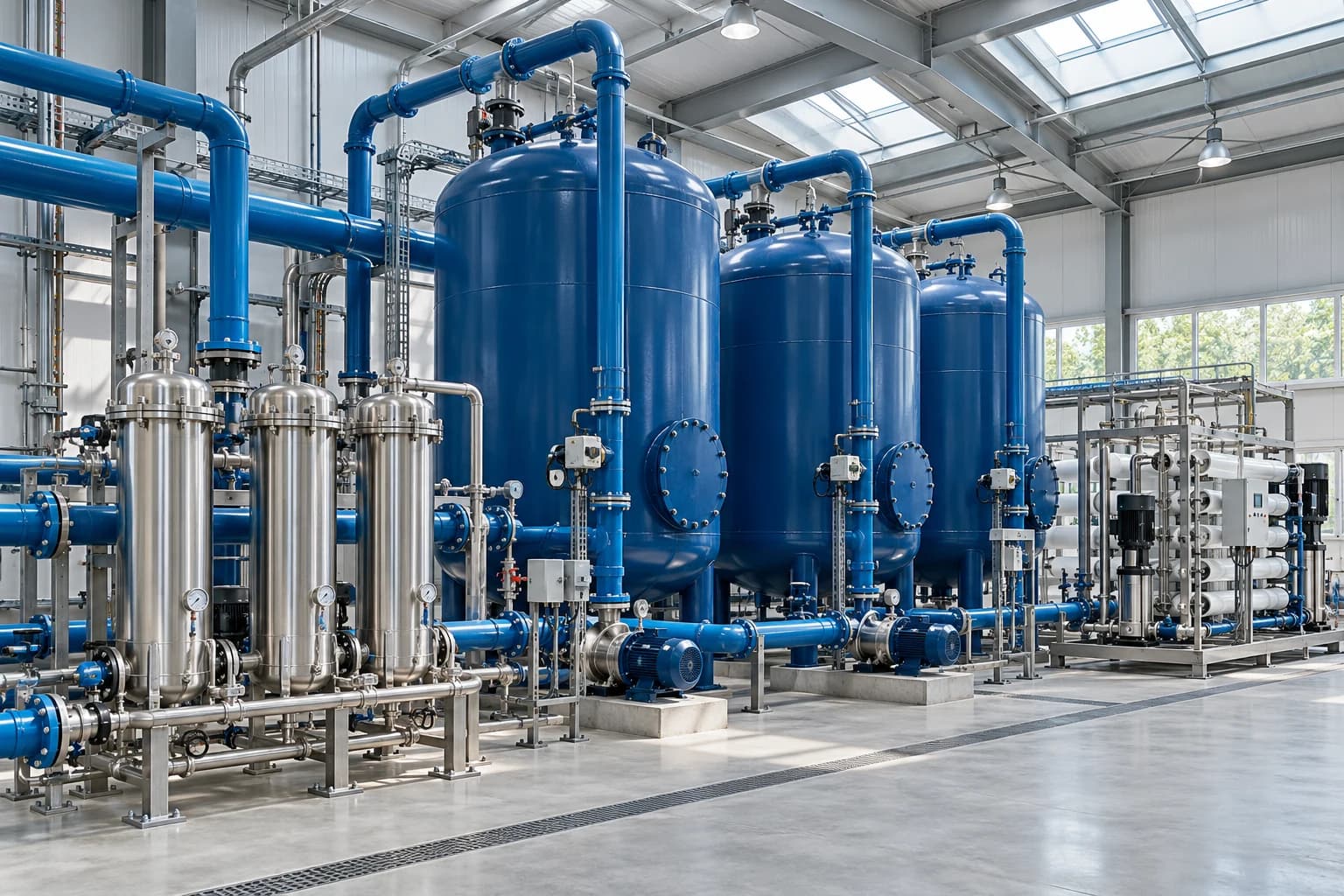
Blue pressure filters, stainless filter housings and supply piping in a clean-water purification hall

In short

What does a water treatment system do?

A water treatment system removes or reduces suspended solids, dissolved salts, hardness, organic matter, microorganisms and other contaminants so that water from a raw source — such as a borewell, surface water or a municipal supply — reaches the quality required for its intended use. The stages required depend on the source-water quality and on whether the water is for process, utility, potable or high-purity applications.

The challenge

Why one water source can need very different treatment

The same raw water can be treated very differently depending on where it is going.

  • 01

    Source variability

    Borewell, surface and supplied water differ, and quality can change with the season.

  • 02

    Application standard

    Process, utility, potable and high-purity uses each demand a different quality.

  • 03

    Consistency

    Production and utilities need water of the right quality every day, not occasionally.

  • 04

    Operability

    The system must be practical for the site's own team to run and maintain.

Engineering approach

How a water treatment system is developed

The source sets the starting point; the point of use sets the target.

  1. 01

    Characterise the source

    Analyse the raw water and how its quality varies.

  2. 02

    Define point-of-use quality

    Set the quality each application requires.

  3. 03

    Select the treatment train

    Combine pre-treatment, purification and polishing stages.

  4. 04

    Engineer and commission

    Design, supply, installation, testing and commissioning.

  5. 05

    Monitor and maintain

    Water-quality monitoring, servicing, consumables and spares.

Process pathway

A typical water treatment pathway

  1. 01

    Source

    Characterise the incoming raw, borewell, surface or process water.

  2. 02

    Pre-treatment

    Remove material that would interfere with downstream treatment.

  3. 03

    Purification

    Select separation and conditioning stages for the target quality.

  4. 04

    Polishing

    Refine the water where the application requires tighter quality control.

  5. 05

    Process or high-purity use

    Deliver fit-for-purpose water to the intended application.

An illustrative pathway from source to use. Each stage is selected and sized for the source water and the application.

Scope

Water treatment capabilities

Water treatment from Unisavour Industries Limited covers:

  • Pre-treatment
  • Purification
  • Process water treatment
  • High-purity water requirements
  • Water distribution
  • Water-quality monitoring

Common questions

What buyers ask about water treatment.

What information is needed to design a water treatment system?

A water treatment design is built on six pieces of information:

  1. 1Water source: borewell, surface water, municipal supply or another source.
  2. 2Raw-water analysis: the contaminants present and how much they vary.
  3. 3Required quality: the quality needed at each point of use.
  4. 4Demand: daily volume and peak requirement.
  5. 5Site and utilities: available space, power and storage.
  6. 6Existing treatment: any equipment already installed and how it performs.

How is process water different from potable water?

Potable water is treated to the quality required for drinking and must meet the applicable drinking-water requirements. Process water is treated to the quality a specific industrial use requires, which can be more or less stringent than drinking water for particular parameters such as hardness or dissolved salts.

What is high-purity water?

High-purity water has very low levels of dissolved salts and other impurities and is required by some manufacturing, laboratory and pharmaceutical applications. It is typically produced by adding membrane separation and polishing stages after conventional pre-treatment and purification.

Why does raw-water analysis matter?

The analysis shows which contaminants are present and at what levels. Designing without it risks selecting stages that are inadequate or unnecessary, and can lead to fouling, scaling or inconsistent water quality.

Water Treatment

Planning a water treatment system?

Share the water source, any available analysis, the daily demand and the application the water is for.Don't have complete technical data yet? Share what you know — our team can help identify what is needed for the next step.